The White Hurricane of 1913…
…started on November 7th when storm flags began to be displayed by weather stations. While hurricane warnings are almost never necessary on the Great Lakes, this storm reached the standard of one.[1] It cast snow and rain across the Lakes and areas with winds between seventy and ninety miles per hour, exceeding hurricane force winds at seventy-four miles per hour.[2] On November 10th the storm receded, leaving a wake of nineteen vessels completely destroyed, ten vessels stranded, and the lives of 251 sailors lost.[3][4]
Captain C.W. Watson of the steamer George F. Bownell described his experience in the storm and the sight of White Shoal in it: “At 10:27 P.M. we passed White Shoal and saw Simmon’s Reef gas buoy in the Straits. The snow increased and at 12:30 A.M. we stopped and let both our anchors down ten fathoms.”[5]
[1] Frank Barcus, Freshwater Fury: Yarns and Reminiscences of the Greatest Storm in Inland Navigation (Detroit: Wayne State University Press, 1960), 3. [2] Richard Wagenmaker and Greg Mann, “The “White Hurricane” Storm of November 1913 A Numerical Model Retrospective” (lecture) 5. [3] Barcus, 119. [4] Barcus,133-136. [5] Barcus, 119.
The Perilous Adventure of Lewis Sweet…
…is a book written about the true story of Lewis Sweet’s endangerment and eventual rescue. From January 20-29th 1929 the fisherman found himself stranded on an ice flow in Lake Michigan where he sought refuge in White Shoal. Impressed by Sweet’s tale O.J. Laylander recorded it in 1929, “to be printed an edition of a few hundred copies of this brochure, and have given them to Mr. Sweet, with the hope that he may serve some slight revenue therefrom.”[1]
Born on November 23rd, 1875 Sweet was fifty-four years old at the time of his endangerment.[2][3] In January of 1929 he joined his neighbors and friends Walter Scott and Chester Lee on an ice- fishing expedition at Scott’s cabin on Crane Island. Located about eight miles from Cross Village, Michigan this rugged tract of land is roughly four square miles and is uninhabited aside from visiting fishermen and trappers.[4][5][6] The shipping season in the Great Lakes had concluded two months prior as the lakes begin to freeze and weather became unpredictable.[7]
On January 18th Sweet, Scott, and Lee arrived at Crane Island and prepared for their week long excursion by tending to their shanties. Monday was uneventful for Sweet as he only caught one fish. The next day proved to be a day he would not forget.[8] Sweet stationed his shanty near his companions and by one that afternoon he caught a twenty-pound fish. When he left his shelter to disengage his fish from his spear he found his companions had taken the dog sled and returned to the island one mile away.[9] Scott and Lee had grown uncomfortable with the weather and returned to the cabin; they had called for Sweet to come in but it was apparent he either did not hear them or wanted to try his luck for another fish. A half hour later a storm that had hit the northwest with temperature ranging from ten to thirty-degrees below zero hit.[10][11]
Gales struck Sweet’s shelter driving wet, heavy snow into drifts that froze with the dropping temperatures. The dense snowfall did not allow for any visibility and judging by the direction of his shanty Sweet headed for where he believed the island was with his ax and fish. He stumbled upon a crack in the ice too wide to cross and realized that the ice had broken under the windward pressure and retreated back to his shelter but was unable to find it due to the storm.[12]
Knowing he would not survive in the open long Sweet built a windbreak out of frozen snow. Though it was impossible to tell how big the ice floe was Sweet remained where he believed the middle of it to be, resting for a time and moving around to keep warm.[13] A portion of the floe broke off ahead of him and, believing it was the main floe, Sweet jumped across to it and built a new shelter where he continued moving to keep warm and rest. He had kept his fish and axe throughout the ordeal as he believed they would aid him in survival.[14] At this point the temperature had dropped well before zero and with the wind bearing down upon the floe the ice split again, and again Sweet jumped to the main piece. Unfortunately this time he missed his footing and ended up waist deep in the water; he was able to pull himself out, build a third shelter, and continue to move to keep body heat.[15]
Sweet struggled throughout the night to stay awake and warm; the snowfall had lessened but cold increased. Throughout the next day he struggled to stay awake, stumbling, falling, and slapping himself to keep moving.[16] The next evening he believed he saw a light and, hoping it was a boat, he called to hail it. This came to no avail and as the night went on the shape of a light tower began to appear with the light’s intermittent flash.[17] Though Sweet was able to see White Shoal Light the wind had shifted, driving the ice floe away from the structure and back into the Straits of Mackinac.[18] For twelve hours he floated in darkness until the morning. With the storm clearing the wind changed directions and blew heavily from the north, driving Sweet straight for White Shoal Light.[19]
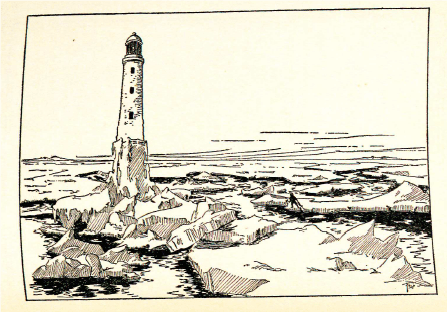
Though White Shoal does not sit on any land it appeared as through it rested on an island of ice, “the winter winds had wrapped the structure in a coat of frozen spray, and all about its base for two to three hundred feet were jagged piles of ice.”[20] Knowing the floe he was on was shrinking Sweet believed White Shoal was his only hope. Sweet describes what happed as the flow struck the ice at the base of the light: “its edge crumbled and I had to run for my life to escape the great sheet that doubled back toward where I had taken my position.”[21] He made his way across the ice and to the base of the structure. As shipping season had ended two months prior the keepers who usually manned the structure were gone.[22] The ladder to the tower was encased in ice so after multiple attempts he was forced to cut a stairway using the ice around the base and was able to pull himself up with a guard chain at the top. Breaking the door of the tower Sweet entered and found emergency supplies left in the station.[23]
After finding a bed and change of clothes Sweet learned the full toll exposure had taken on his body: his shoes where frozen to his feet and his hands and feet were covered in open blisters. Using the materials he could find he dressed and cared for his wounds as best he could.[24] Sweet was able to keep warm on the station and cook meals from the leftover supplies. The night he found the station was also the last night the light flashed as its emergency supply for automatic contrivance had run out.[25]
On the morning of the 21st of January Scott returned to Cross Village to report Sweet missing and seek help. Together the citizens of Cross Village and Petoskey organized search parties and scoured the shore in hopes of finding Sweet.[26] Communication was made with Governor Green of Michigan who dispatched Mr. Olander of Lansing, the Commissioner of Public Safety, in his plane to search the region by air. Two Army planes were requested and sent from Selfridge Field in Detroit to aid in the search. They scoured the region from Beaver Island to the Straits.[27] The rescue planes were equipped with skis and could land on the ice. Though the planes scanned the region Thursday nothing was found of Sweet and many believed no one could survive that long in the storm.[28] On Friday a second storm hit the area, grounding all planes in Petoskey. At this point hope was given up and the search ceased.[29]
Sweet remained on White Shoal Light for four days.[30] Though he heard the hum of planes overhead he was too sick and sore to climb up the tower in time to signal a pilot, and continued to care for his hands and feet. Later he displayed signal flags that were not visible in the winter from a considerable distance.[31] While Sweet was at the light the ice had broken up along the land, though by Saturday night the temperature dropped and by Sunday a sheet of ice stretched from White Shoal to land. That morning Sweet began to make the seventeen mile trek to Cross Village.[32]
Sweet was in too much pain to use the ice stairway he had constructed to enter the tower and instead lowed himself from White Shoal to the surface of the ice with a rope. He attempted to take the smoother paths of ice and passed by Crane Island; he was tempted to see if any fisherman there could help but continued on in hope of finding relief in Cross Village.[33] With the weather conditions being unfavorable Sweet lost his way and when he did find land he was eight miles north of Cross Village on the desolate shore of Sturgeon Bay. There he found a fisherman’s shack and took shelter for the night.[34] He remained in the shack from Sunday night until Tuesday morning to gather his strength. As he made his way through the snow drifts that lined the shore and up the bluff to Cross Village he scared two native girls as he approached as they likely though him to be a drunk. A passerby helped him into the store of Henry Cetos and Sweet was gladly welcomed back.[35]
It took only minutes for word to spread that Sweet had survived the storm and elements; a message was sent to his family in Alanson and Henry Sullivan, Sweet’s acquaintance in Cross Village who had been most active in the search, took him to his home. Physician’s instructions were sent from Petoskey for immediate care as they prepared to move him to thirty-five miles away to the hospital in Petoskey.[36] The first twelve miles were traveled slowly by horse and sled through snow drifts; the rest was traveled by car sent from friends in Petoskey who were overjoyed at the news of Sweet’s rescue.[37]
The proprietor of the Petoskey Hospital, Dr. John J. Reycraft, personally cared for Sweet as a patient. Ten weeks were spent recovering in the hospital; during this time all of Sweet’s toes and parts of all his fingers were amputated. As soon as he was able he returned to his home in Alanson with his wife and children.[38]
[1]O.J. Laylander, The Perilous Adventureof Lewis Sweet (Chicago, 1929), 8-9 [1]Laylander, 7. [2]Laylander, 11. [3]Laylander, 11. [4]Laylander, 17. [5]Laylander, 13. [6]Laylander, 15. [7]Layander, 20. [8]Laylander, 21. [9]Laylander, 22. [10]Laylander, 21. [11]Laylander, 22-24. [12]Laylander, 24. [13]Laylander, 25. [14] Laylander, 26. [15]Laylander, 27. [16]Laylander, 28. [17]Laylander, 28-29 [18]Laylander, 29. [19]Laylander, 30. [20]Laylander, 32. [21]Laylander, 31-32. [22]Laylander, 33-34 [23]Laylander, 34-36. [24]Laylander, 35-36. [25]Laylander, 37. [26]Laylander, 38. [27]Laylander, 39. [28]Laylander, 40. [29]Laylander, 37. [30]Laylander, 40-41. [31]Laylander, 41-43. [31] Laylander, 43. [33]Laylander, 44. [34]Laylander, 45. [35] Laylander, 45-46. [36] Laylander, 46-47. [37]Laylander, 48-50.
The Armistice Day Storm of 1940…
…will forever be a part of weather history in the United States. The weather leading up to this storm brought down the Tacoma Narrows Bridge, nicknamed “Galloping Gertie.” At the time of its destruction it was the third longest suspension bridge in the world and considered an engineering wonder.[1]
The bridge collapsed before the center of the storm reached the shore. The following day the storm hit Washington, producing gale force winds; pressure began to fall over the pacific northwest. On November 10th the storm traveled across the Rocky Mountains, and struck the Midwest on Armistice Day. As many were off for the holiday and the morning weather was warm for that time of year at 50 degrees; duck hunters took to the fields, not dressed for cold weather.[2]
The weather took a turn as day went to night and a tornado was reported west of Davenport, Iowa, 2-3 inches of heavy rain fell over the Mississippi Valley, snow fell across Minnesota and Western Iowa, and gale velocities as high as 80 miles per hour were measured in Grand Rapids, Michigan; it was estimated to be stronger over the lake.[3] The temperature dropped into single digits as the storm centered in on Lake Superior. Over the next twenty-four hours over a foot of snow fell, more than 150 people died, and thousands of livestock were killed due to the extreme weather.[4]
First Assistant Keeper George Keller was on White Shoal Light when the storm struck. In a 1983 interview he reported, “The seas were 25, maybe 35 feet high, 70 feet wide. When the waves hit the deck over the crib, the structure would shake, utensils would fall off the stove and water would leak all over. After the three day blow, I figured we must have had 500 tons of ice on that structure.”[5]
It took Keller and the other crewman stationed on the light several days to chip off enough ice to launch a boat to return to land. “I tell you that nothing looked better than when I got away from that light, and could look back and see that light flashin’ and everything was all right. And there was not that much damage to the station. We didn’t lose a thing,” Keller said of leaving.[6]
Following the storm Keller remembers the lake being dirty. It was not until the following August that the lake the let stirred up silt and mud to settle. It clogged the gills of fish, killing them. They would wash up on the north shore and smelt so thick, “you could pick them up with a hay bailer,” Keller remembers.[7]
[1] “The Armistice Day Blizzard of 1940 Remembered,” National Weather Service, https://www.weather.gov/dvn/armistice_day_blizzard#:~:text=The%20blizzard%20that%20struck%20the,the%20morning%20of%20November%2011th.
[2] The National Weather Service, “The Armistice Day Blizzard of 1940 Remembered.”
[3] The National Weather Service, “The Armistice Day Blizzard of 1940 Remembered.” [4]Mark Fellows, “Lighthouse Keeper Remembers,” Little Traverse Trading Times, December 14-20, 1983. [5]Fellows, “Lighthouse Keeper Remembers.” [6]Fellows, “Lighthouse Keeper Remembers.” [7]Fellows, “Lighthouse Keeper Remembers.”
The Bombing of Waugoshance Light…
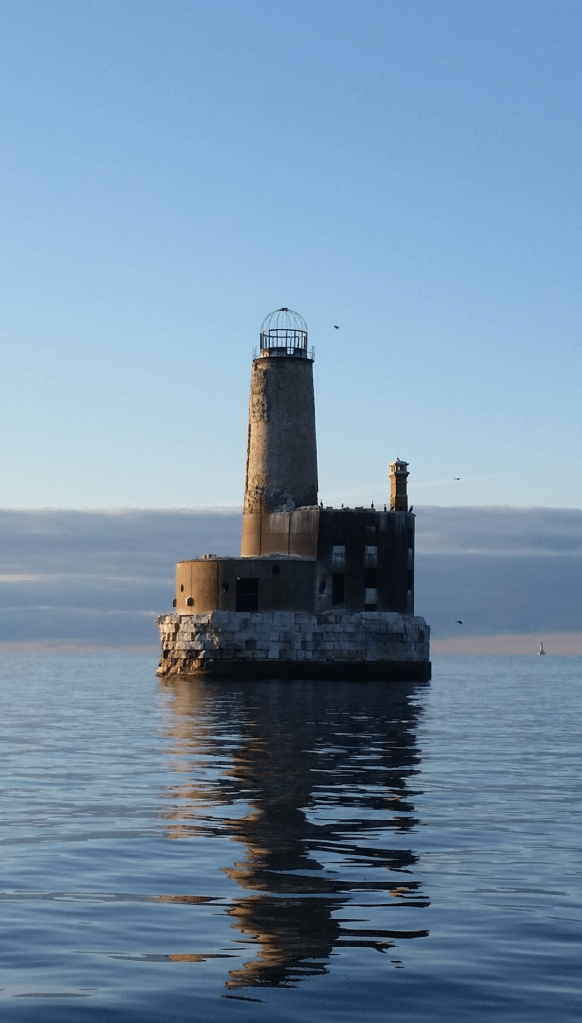
…was a form of target practice for the US military pilots in training during World War II. The missiles dropped here struck their target and a fire broke loose on the structure destroying the keeper’s quarters and gutting the tower.[1] The Navy’s secret training missions allowed for pilots to test radio controlled drones. The program was codenamed STAG-1 and was the American response to Kamikaze attacks.[2]
Primitive radio receivers were connected to the steering of twin engine planes by engineers. “They had a television camera in the nose, and a hydraulic unit that was controlled by radio impulses for each operation they wanted to control,” said Aviation Machinist Michael L. Beshara.[3] Pilots would trail several miles behind in the “mothership” steering the drones. Once the 2,000 pound bombs were dropped the expendable drones crashed into the waters of Lake Michigan.[4] After three months of testing and improving the drones the program was considered feasible and the testing left the Great Lakes. The drones were used a few times during World War II. [5]
Just over four miles from White Shoal the explosions would likely have been heard by the keepers. In 2005 the Navy’s Underwater Ordnance Recovery Unit surveyed the area and located several bombs on the lake bottom.[6] These were safely detonated in the water and the area has been deemed safe. Today the frame of an airplane glider is still visible and often boaters steer clear of the area around Waugoshance for fear of undetonated missiles.[7]
[1]“Waugoshance Shoal Lighthouse,” Seeing the Light, last modified August 13, 2005, http://www.terrypepper.com/lights/michigan/waugoshance/waugoshance.htm. [2]”Ruins of the Waugoshance Light Station,” Atlas Obscura, https://www.atlasobscura.com/places/ruins-waugoshance-lighthouse. [3]Atlas Obscura, “Ruins of the Waugoshance Light Station.” [4]Atlas Obscura, “Ruins of the Waugoshance Light Station.” [5]”Life After Wartime: The Fate of Waugoshance Lighthouse,” Express, last modified November 4, 2016, https://www.northernexpress.com/news/feature/article-7908-life-after-wartime/. [6]Express, “Life After Wartime: The Fate of Waugoshance Lighthouse.” [7]Express, “Life After Wartime: The Fate of Waugoshance Lighthouse.”
 Light Listening: Stories from Behind the Lens of White Shoal