Lighthouses began operation on the Great Lakes in the early nineteenth century. The first was constructed on Lake Erie as a part of Fort Niagara in 1818. Five more were established by 1822, one on Lake Erie and the remaining four on Lake Ontario.[1] The first lighthouses established on Lake Michigan were the Chicago Harbor Light and the light at the entrance to the St. Joseph River in 1832. That same year, the first lightship on the Great Lakes was stationed at Waugoshance Shoal, just five miles south of White Shoal, and served from 1832 until 1851 when it was replaced by Waugoshance Lighthouse.[2] This tower underwent multiple alterations until it was abandoned in 1912 after the establishment of White Shoal Light.[3] Below is a timeline that illustrates several significant events the light tower at White Shoal underwent prior to its transition into private ownership.
Terminology Note: The words “lighthouse,” “light station,” “light tower,” “light,” and “tower” are all used interchangeably to describe the structure of White Shoal and others like it. “Light ship” or “light vessel” referrers to a boat stationed out on a shoal or reef manned by a crew tasked with keeping a light burning to guide others around the underwater obstruction.
[1] Charles K. Hyde, The Northern Lights: Lighthouses in the Upper Great Lakes (Detroit: Wayne State University Press, 1998), 15. [2] Hyde, 16. [3] Hyde, 103.
1880s
Increased marine traffic through the Straits of Mackinac causes Lighthouse Board to evaluate the area and deem White Shoal a navigational hazard
1891
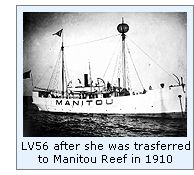
Lightship LV56 is stationed at White Shoal
1906
The Lighthouse Board petitions congress for the funding to build a light station on White Shoal
1907
On March 4th the funding is approved
1908
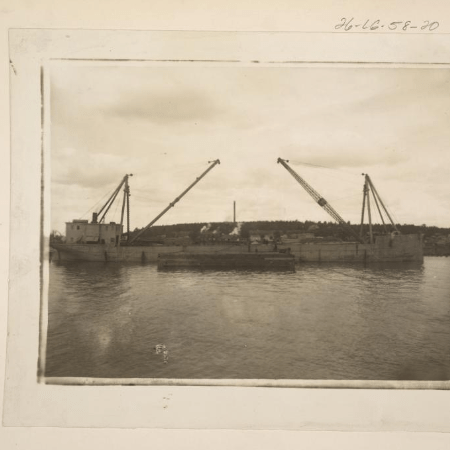
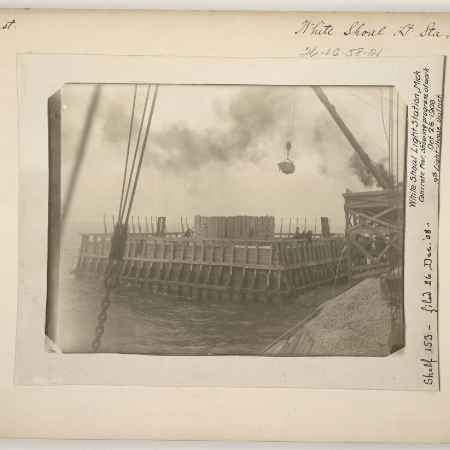
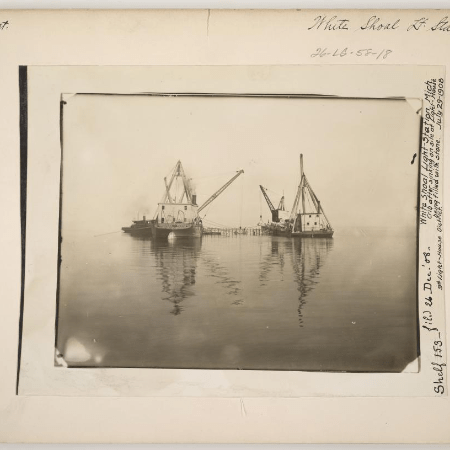
Work begins on White Shoal light station
“White Shoal Lighthouse,” Seeing the Light, last modified February 22, 2004, http://www.terrypepper.com/lights/michigan/whiteshoal/whiteshoal.htm.
1910
On September 1st the second-order by-valve lens is lit for the first time; the light tower’s day mark* is white
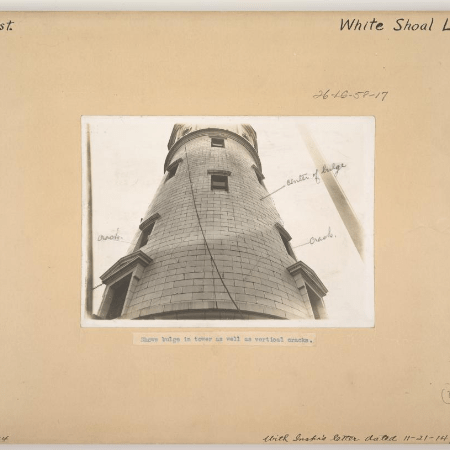
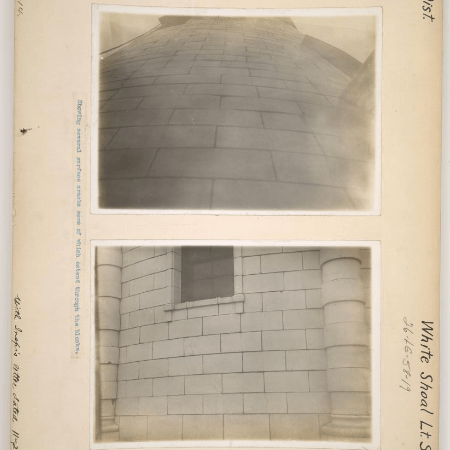
*daymark refers to the paint pattern the structure boasts. Each is unique and allows them to be identified in the daylight
1911
Submarine bell installed
1913
Installation of deck crane for loading and unloading of supplies and to lift boats
1914
Six inch whistles on the light replaced with ten inch whistles to improve the station efficacy
1914
Submarine bell disconnected by the end of the season as it proved less successful then intended
1927
The tower’s day mark is painted black
“White Shoal Lighthouse,” Seeing the Light
1930
Twin diesel engine-powered generators are installed in the mechanical room increasing the light’s output to 3,000,000 candle power
1937
The tower’s day mark is repainted white
1939
Coast Guard assumes control of the light station and assigns four-man crews to the station. They work fourteen days on the station, with a seven day leave; three men are always on the structure
1954
White Shoal is given the day mark it still holds today: its red and white candy-cane stripe
1976
the light station is automated, meaning a crew is no longer needed to maintain the structure
1983
The second order lens is dismantled and relocated to the Shipwreck Museum at Whitefish Point Station where it is still on display
1990
Tower repainted with its iconic red and white stripe by the Coast Guard
“White Shoal Lighthouse,” Seeing the Light
 Light Listening: Stories from Behind the Lens of White Shoal